
Jefferson County Court Records After Arrest
A Jefferson County arrest usually starts with a law-enforcement agency, jail intake, and a public jail roster entry. The later court record is different. The Jefferson County Prosecutor's Office represents the State of Indiana in felony, misdemeanor, traffic, and juvenile prosecutions, and the prosecutor files formal charges after the arrest investigation is reviewed. Once filed, the case is maintained in Jefferson County courts, and the Jefferson County Clerk administers official trial-court records for those cases.
The jail side and the court side should be read together. The roster may show arrest date, warrant language, bond lines, and charge text, while the court case shows the filed count, court, case number, events, hearings, and disposition. Custody and booking details belong with Jefferson County jail inmate records; booking photos are addressed through Jefferson County jail mugshots. Court records after a jail arrest answer a different question: what criminal case was opened, what charge was filed, and what happened next.
The Jefferson County Circuit and Superior Courts both sit in Madison. The Circuit Court handles criminal matters involving murder and Level 1 through Level 4 felonies, while Superior Court also handles local court business from the same government center. Court assignment matters because the official court record is maintained by the court and Clerk, not by the jail roster vendor.
Find Jefferson County Court Records
Indiana's public case-search portal is MyCase, also reached through mycase.in.gov. MyCase is the practical first stop for Jefferson County court records after an arrest because it can show case summaries, charges, case events, hearing settings, and some available documents. The Indiana Judicial Branch also notes that some court documents are available at no cost through MyCase, while records not available online should be requested from the clerk in the county where the case is heard.
- Start with the jail roster if the arrest date, spelling, charge phrase, or warrant number is unknown.
- Open MyCase and search by party name, case number, citation number, attorney, or court and county filters.
- Narrow the search to Jefferson County when common names return too many Indiana cases.
- Open the criminal case and compare the court charge list with the jail charge or hold line.
- Contact the Clerk or court office when a filing, older record, or certified copy is not visible online.
The MyCase help materials warn that online information is not the official court record. For official records, use the court that maintains the case or the Jefferson County Clerk. The Clerk's archive form states that archived court-filed documents go back to 1811, digital copies may be emailed free, and paper copies are $1 per page.
The MyCase search screen is the state portal used for defendant and case searches.
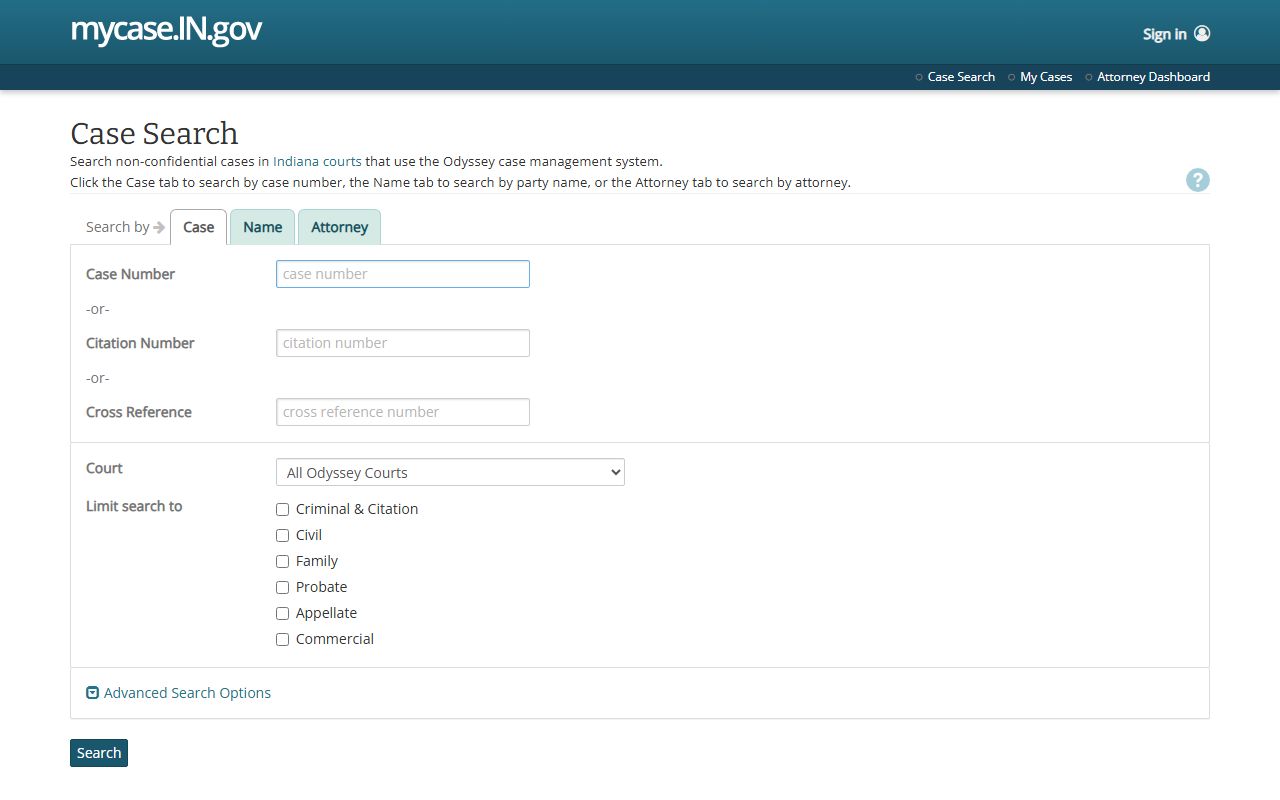
Use the court and county filters when a name search returns cases from other Indiana counties.
Jefferson County MyCase Fields
MyCase is broader than a jail roster. It searches court cases, so the useful fields are tied to parties, cases, citations, courts, and dates rather than booking status. A person may appear in MyCase even after release from jail, and a person booked at the jail may not appear until charges are filed or a warrant case is created.
| Field Label | Type | Required | Notes |
|---|---|---|---|
| Case Number | Text | No | Best when the case number is known from a notice, bond paper, or Clerk record. |
| Party Name | Text | No | Search by defendant or party name; full names narrow common results. |
| Attorney | Text | No | Useful when counsel is known but the case number is not. |
| Citation Number | Text | No | Used for traffic, citation, and infraction records. |
| Court or County | Filter | No | Choose Jefferson County to separate local cases from statewide matches. |
| Case Type | Filter | No | Criminal, civil, citation, infraction, and other case groups may be available. |
| Date Range | Filter | No | Filing or hearing date filters may help when the arrest date is known. |
Jefferson County Charging Documents
After booking, the prosecutor's charging document is what turns an arrest event into a court case. The jail may list a suspected offense or warrant reason before the prosecutor decides the exact filed count. That is why court records after a jail arrest can show a different offense level, added count, amended count, or dismissal. The filed document and later docket entries control the court case, not the first roster phrase.
| Document | Filed By | What It Does | Why It Matters |
|---|---|---|---|
| Complaint | Law enforcement or prosecutor | States the offense allegation and facts used to start or support a case. | Often appears early in a case and may track the arrest narrative. |
| Information | Prosecutor | Lists the formal criminal count filed by the State of Indiana. | Shows the prosecutor's charging decision after review. |
| Indictment | Grand jury | Formal accusation returned through a grand-jury process. | Less routine, but it is still a charging document when used. |
The Prosecutor directory lists the Prosecutor's Office at 315 1/2 E Second Street in Madison, with weekday business hours. David R. Sutter is listed by the county as the Jefferson County Prosecutor. Charging decisions, victim services, and case preparation run through that office, while the court record itself remains with the court and Clerk.
The county's Prosecutor page explains the local criminal prosecution role.
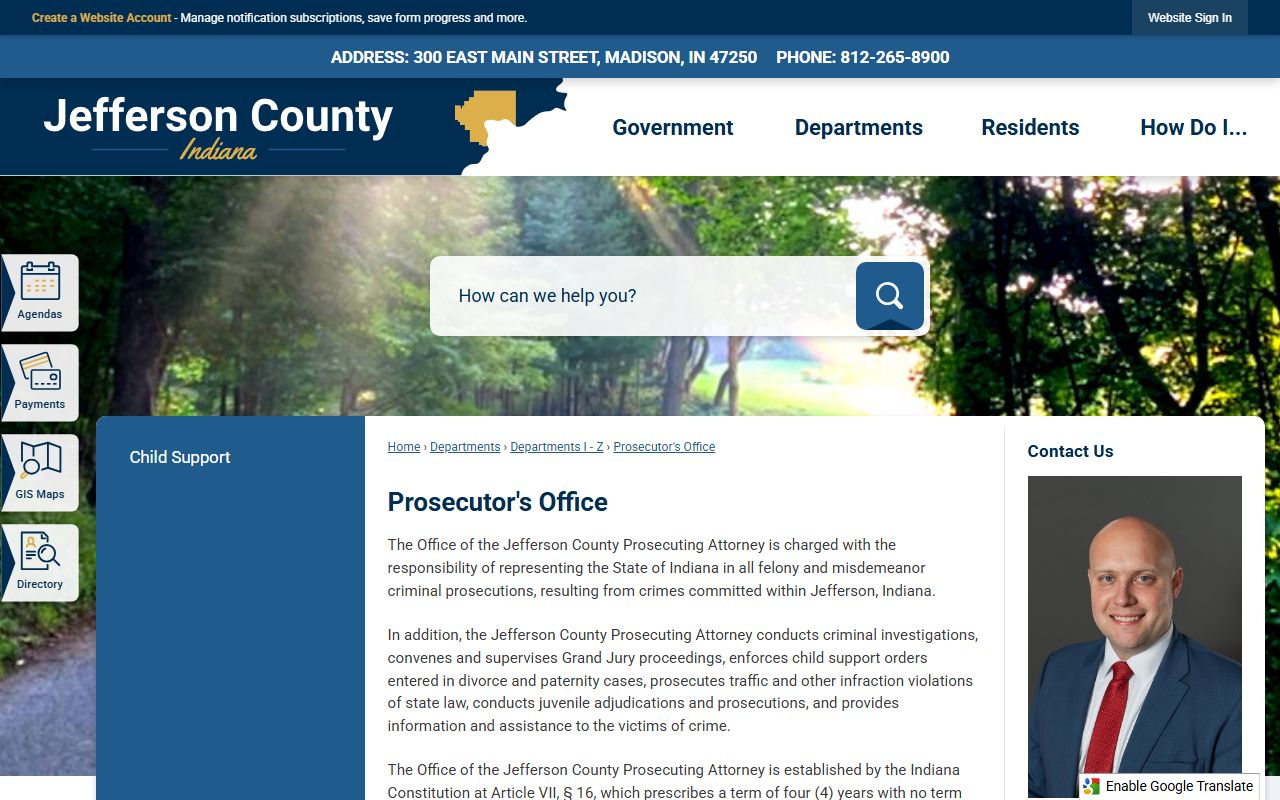
That office is the charging source to compare against the first jail booking description.
Jefferson County Charge Status
Charge status is the part of the court record that shows whether a count is still active, changed, or resolved. Booking entries may remain useful for arrest history, but they do not prove a conviction. A Jefferson County court record can show a charge as pending at first, then later amended, reduced, dismissed, convicted, disposed, or tied to a warrant event.
| Status | What It Means | Common Record Clue |
|---|---|---|
| Pending | The charge or case has not reached final outcome. | Future hearing or open event appears. |
| Amended | The prosecutor changed the charge wording, count, or offense level. | New charging entry or amended filing appears. |
| Reduced | The filed charge was lowered to a lesser offense or level. | Plea or amended charge entry may show a lower count. |
| Dismissed | The charge was ended by the prosecutor or court. | Dismissal entry appears for that count or case. |
| Convicted | Guilt was entered by plea or verdict. | Judgment, plea, or sentencing event appears. |
| Disposed | The case or charge reached a final outcome. | Final disposition entry appears. |
| Warrant Issued | A court issued an arrest or bench warrant related to the case. | Warrant event may appear in MyCase and jail hold lines. |
Bond After Jefferson County Arrest
Bond information can appear in the jail roster, the court docket, or both. Jefferson County's inmate information page says after an initial hearing, bond may be paid at the Jefferson County Clerk's Office, and the Clerk charges a $5 fee on all bonds. Any bond over $10,000 must be paid at the Clerk's Office. The receipt must then be brought back to the Sheriff's Office Jail Division so jail staff can verify it before release.
The same county source has a payment-method conflict for jail payments. It says pre-initial-hearing bonds and after-hours bonds can be paid with cash at the Sheriff's Office 24 hours a day, but it also says bond paid at the jail must be paid with debit or credit card. Call Jail Control before traveling, especially after hours or before the first hearing. Photo ID is required when posting bond, and local bond payment may not clear a hold from ICE, U.S. Marshals, parole, another county, or another state.
| Bond Item | Jefferson County Detail |
|---|---|
| Clerk fee | $5 on all bonds paid through the Clerk. |
| Bonds over $10,000 | Paid at the Jefferson County Clerk's Office. |
| After initial hearing | Pay at Clerk, then bring receipt to Jail Division for verification. |
| Before initial hearing or after hours | County text references Sheriff's Office or jail payment, but payment method should be verified by phone. |
| Other-agency hold | May block release even when local bond is paid. |
Note: Bond language on the roster can include "Cash Only," "Set By Judge," or "Set By Preset Bond"; verify the current amount and payment channel before relying on an older screenshot.
Warrants and Court Records
Jefferson County does not have a separate official public active-warrant search page in the researched county sources. Warrant clues can appear in two places after an arrest: the jail roster hold line and the court case events. The Sheriff's Office is responsible for serving protective orders and warrants, and the Transport and Fugitive Warrant Unit number is 812-274-2646. Jail Control can confirm current custody, but court-origin bench warrant questions often require MyCase, the court office, the Clerk, or legal counsel.
Roster records observed in research included warrant phrases with warrant numbers, issuing jurisdiction, bond type, amount, and judge or preset-bond notation. A warrant case can also have a separate court history, especially when it comes from probation violation, failure to appear, or a bench warrant tied to an older criminal case. Indiana VINE or SAVIN can help with custody notifications after a person is in custody, but it is not a substitute for an official court or warrant record.
Charge vs Conviction
A charge is an allegation. A conviction is a final legal outcome after a guilty plea, verdict, or other judgment of guilt. Jefferson County court records after a jail arrest can contain both types of entries, so the exact status should be read before treating a case as resolved. The distinction matters for employment, housing, licenses, immigration, and any other setting where a public record may be misunderstood.
| Point | Charge | Conviction |
|---|---|---|
| Meaning | Offense alleged by the state. | Guilt entered by plea or verdict. |
| Timing | Appears early after filing. | Appears after adjudication or plea. |
| Can change | May be amended, reduced, or dismissed. | Can be appealed, corrected, or later restricted only through proper legal process. |
| Where to verify | MyCase, court, and Clerk records. | Final disposition and sentencing entries in the official court record. |
Sealed vs Expunged Records
Public access has limits. Indiana's Access to Public Records Act, IC 5-14-3, presumes public agency records are open unless an exception applies. The same title includes exemptions that can restrict confidential records, protected court material, some law-enforcement material, juvenile records, and other records made confidential by law or court order. MyCase may also omit documents that remain available only from the maintaining court or Clerk.
| Record Limit | Plain Meaning | Where to Verify |
|---|---|---|
| Sealed | Public access is restricted by law or court order, while the court may retain the record. | Maintaining court or Jefferson County Clerk. |
| Expunged | A statutory court process restricts public access or changes how an eligible record may be treated. | Expungement order and Clerk record. |
| Dismissed | The charge ended, but a dismissal is not the same thing as automatic sealing. | Case docket and final order. |
| Juvenile or protected case | Public access may be limited even when an arrest or court event occurred. | Court office, Clerk, or counsel. |
The Indiana Judicial Branch public-records page is the statewide starting point for court record access. For Jefferson County documents not displayed online, use the Clerk or the court that maintains the case. Do not assume that a missing MyCase document means no court record exists.
The state public-records guidance explains the MyCase and clerk fallback.
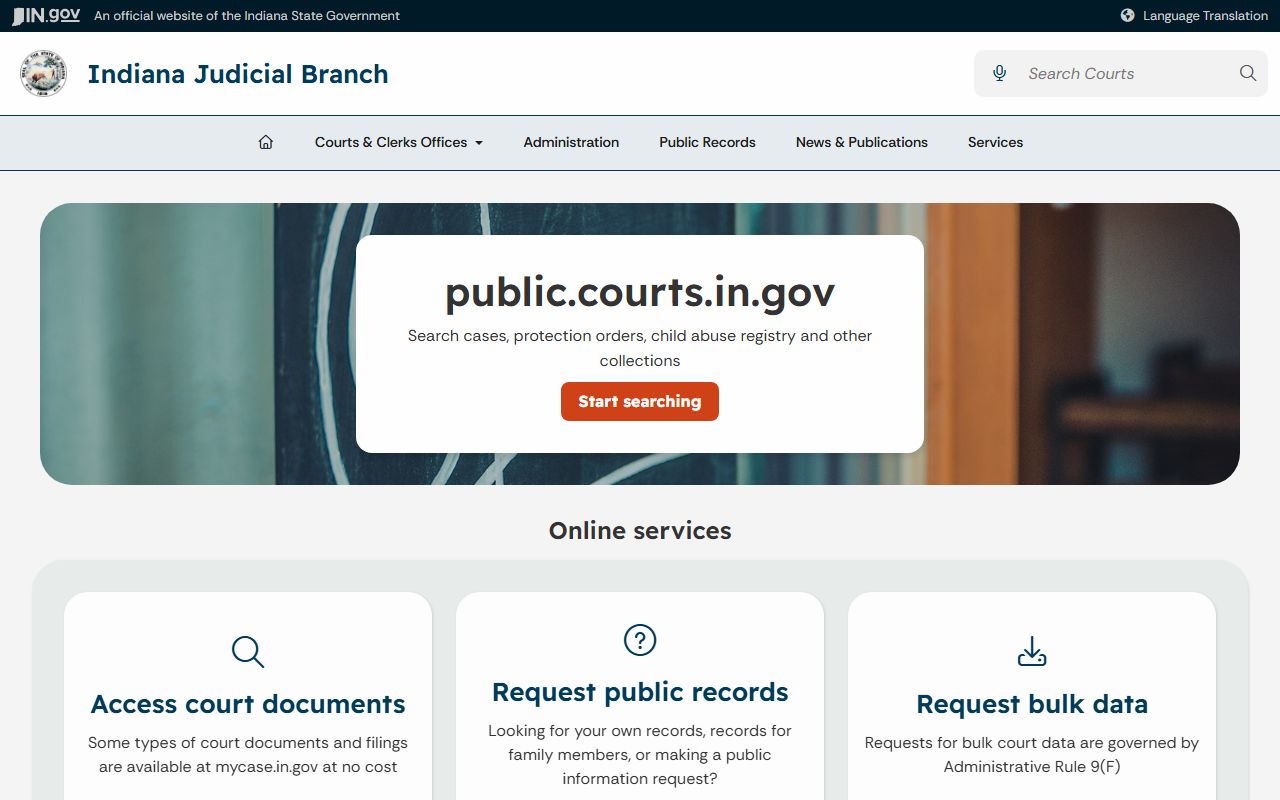
That fallback is important for older files, missing filings, certified copies, and documents outside the public portal.
Restricted Jefferson County Court Records
Some records tied to an arrest may be incomplete online, protected, or held by a different agency. Juvenile matters, sealed records, confidential filings, protected personal information, active investigatory material, and certain law-enforcement records may be limited under Indiana law or court rules. The jail roster also does not show court dates in the public row, and the roster's charge text may not match the prosecutor's final filed charge.
Important: Public record lookup data is not consumer-reporting data and cannot be used for FCRA-covered decisions.
The safest verification chain is source based: roster and Jail Control for custody, Prosecutor filings for charges, MyCase for public court events, and the Clerk or maintaining court for official records. For older files, the Clerk archive request is the local path. For sentenced state-prison custody after a conviction, use the Indiana Department of Correction rather than the county jail roster.